Saturday, November 24, 2007

Daytrip to the west of Pune

Nari has written a detailed trip report, so I won't. The trip was useful to figure out if the bike and I liked each other, and what my present level of fitness is. My findings:
  1. The bike is quite cool to ride for long distances, except for two sticking points: Firstly, the lack of a carrier on which to strap my cycling and photography gear, which meant I had to haul the backpack, leading to back pain later. Secondly, the stiff seat made for painful cycling after about 40km. I switched cycles with Nari for a bit, and found that although his Ranger Swing was heavier and unwield-ier, it was much more comfortable.
  2. My fitness level is worse than a guy who watches golf on television.
Nari in his sleeves-ripped-off tee

The first thing to give way in the cycle was the front mudguard, which just fell off after about 20km. Since there was no water on the road anyplace, the lack of a mudguard was not much of a problem:
Storks

Nari gets sugarcane. I think I need a walking cane.

Friday, November 16, 2007

Hero Octane DTB1

After thinking about it for many years, I finally went and got myself a bicycle again! I was looking primarily for a cycle that would be lighter than a steel-frame one. I also didn't want to spend too much, since I didn't know how much I would be riding a cycle after more than ten years off the saddle. After some internet research, I decided that Hero Cycles made some alloy cycles that were within my budget. Went to the local Hero showroom, and a few test rides later, was the proud owner of a Hero Octane DTB1. (On prodding, the dealer revealed that DTB stood for Dirt Terrain Bike. Whatever!)

Since I found few pictures of this cycle on the internet, here are some hi-res scans of amateur pics I took inside my apartment:

3*7 speed Shimano gears, with rotational shifters. Observe the lack of a carrier, and the plastic mudguards. No pillion-riding on this bike for sure ;) But I'll need to figure out a way to strap on luggage for the long multi-day rides...

Closeup of the rear suspension. The stiffness of the spring is adjustable using a hand-screw:
The quick-release seat. One drawback I later realized, is that the seat has no support springs, making it quite hard and uncomfortable for longer rides:

The bicycle cost me Rs 5,600 in Pune. Senti bought a slightly different cycle called the DTB2 at the same time as I did, and for the same price. Cycling days are here again!

Friday, September 01, 2006

Epilogue

This is a log of a journey made on cycle from Bombay (now Mumbai) to Kanyakumari in 1997. This is not a blog in the truest sense, since it was not uploaded in real time. Instead, the original trip log (which exists as a battered and dirty notebook) was deciphered and typed out, and the old stained photographs (whose negatives have gone missing) were manually scanned and uploaded to Blogger.

Looking back, it was a trip fueled entirely by enthusiasm and the spirit of adventure. Being students, we had little money (the entire cycle journey was completed in Rs2,500 - the equivalent of Rs4,050 today, or US$88 at the present exchange rate). We also weren't bothered too much by the unknowns before we started - such as where we'd stay each night, or what we'd do in an emergency in the midst of nowhere. Communication with loved ones was through lots of postcards, and a weekly phone call back home.

Thanks must go to the great guys I had with me on the trip, primarily to Krishnan, who thought up the idea of cycling to Kanyakumari in the first place and did most of the legwork such as making the rounds of cycle manufacturers, and finally getting brand-new machines, gratis Atlas. Thanks again to our sponsors for their support! Your Goldline Supers were quite reliable and sturdy.

Moving on in time, I must thank Senti for introducing me to blogging and inspiring me to put these notes online, and Tulip, who proofread some of them. The photographs in no way capture the true beauty of the Konkan coast - I used a point-and-shoot then, I was (and still am) a novice photographer, and the photographs show signs of age.

I've not been on such a long cycle trip ever since, but hope that one day this blog will be active with another such experience.

Wednesday, June 04, 1997

The day after...

We woke up really early to catch the sunrise. It was still dark when we went and sat by the temple. A crescent moon had just risen, perhaps an hour back.

Better authors have described a sunrise, so I will not attempt it here. Among the “firsts” that this trek gifted me, this was one – the first time I’d watched a sunrise over the sea (or should that be bay?) A cool 1.5 hours of sitting and watching later, we went to the nearby temple which was crowded and commercialized. Later we had breakfast at a roadside café.

The wind in Kanyakumari is really remarkable. It comes at you from any direction it pleases. It is strong enough to send a spray from the top of waves just when they break. And best of all, it is not the salty, humid kind, but a cool, refreshing one.

In the late morning, after enquiring about return transportation, we went to the Vivekananda Rock. This is a place worth visiting. A classy place, it is maintained meticulously clean. The wind and the view of waves crashing on the rocks around can itself make you wait there for more than a few hours. The other attractions on the island are the Shripad temple and a meditation room. A natural rock formation at Shripad in the shape of a foot is by lore the place where Goddess Parvathi worshipped for getting a husband. We waited at the rock until we were shooed off by the watchies at noon.

We came back to the mainland and had lunch. Shyam and Krishnan are leaving by the 16.05 Madras train while I’ll be waiting to watch the sun set before taking a bus to Trivandrum.


This is the official end of the trip and the end of the daily log. It’s been a pleasurable experience jotting down these notes in the afternoon halt and at the end of a day’s tiring trip. It’s tough to get started when you’re tired, but once into the habit, you discover it adds a lot of fun to your trek.

There is so much beauty in this world. Go out there and discover it.

Tuesday, June 03, 1997

Day 28: Thiruvananthapuram – Kanyakumari

I had a good sleep under the fan until six. Then had a bath. Today we’re gonna go for Kanyakumari. It’s hard to realize this had been our aim all along – I've enjoyed the journey so.

Started at 7:15am. A km on, the highway turned left at a UCO bank junction. Confused or misinformed, Shyam and I went straight on the Kovalam road a few hundred metres. We came back to the junction to find Krishnan missing!

I waited there while Shyam explored every avenue – Kovalam road, highway and back to the control room. No sign of Krishnan. Worried, I waited with the cycles while Shyam took an auto to search further. But in vain.

It was nine by now, and we returned to the control room and told the officer about Krishnan. The officer took down his description and sent out a message on the wireless. Never has any of us been missing for so long.

It is 9:45am now. I’m sitting in the PS compound writing this while Shyam is pacing the streets outside. I’m getting more anxious with every passing minute. This is most un-Krishnan-like.

At 10:30 I decided it was time for some action instead of hanging around for news that wasn't coming. We started cycling along the highway. Asked some of the lukkhas sitting alongside, and found that Krishnan had indeed cycled along that path. Called up a police station near the border and asked them to put a stop to his progress.

Heavy, hot cycling later, we came to Neyyatthinkara (20km). Had lunch in the same place Krishnan had had breakfast. I wondered why the moron was cycling alone!

At Kavakkutilai (32km), we crossed the border - a small sign and Asoka post - into Tamil Nadu, our sixth and last state. Cycled a few km on and rested in a church compound under a tree. It’s hot on the road at 3pm.

Kanyakumari! As I sit here facing the sea, it’s hard to describe my deep satisfaction to be here, as well as that exhilarating, memorable last ride here.

After changing states, we were greeted with a dramatic change of scenery. From the endless coconut palms and continuous village of Kerala, here we were met with hills. Thankfully we did not have to go over any of them. They were solitary high rocky things scattered here and there, mostly to the left. The lush greenery of the banana plantations in the foreground, the clouds kissing the hilltops yonder, is a picture I will not easily forget. And the wind... the entire evening stretch of 50+km we were refreshed by the strong wind. Now and then, we would come across lotus ponds or hyacinth streams. And the spirit... Shyam and I were bubbling with enthusiasm and anticipation throughout. I was on a continuous high and never felt the cycling, the monotonous leg exercise that had become a part of my life for the past month and would soon cease to be. I remembered what Pop had told me once regarding jogging – once you stop feeling the pain and start noticing the countryside, the jog is no longer an exercise but an experience. Luckily this feeling had come to me very near the beginning of the trek.

We reached Nagercoil (68km), from where the road was a continuous flat stretch illuminated at places. A few km on it became dark. Along the road, we were informed that Krishnan was just a few minutes ahead of us but when we finally spotted him in Kanyakumari sipping a cool drink, he said he’d been there hours back. The trio re-formed, but Krishnan was in a major solitary mood. We had cycled 88km today.

Kanyakumari is a big tourist place. Seeing the large number of hotels and lodges, I was for a moment afraid the police wouldn’t accommodate us, but was relieved when they did. It seems fitting to start and end the trek by staying the night at a police station. Perhaps I may not have this experience again.

We had our baths at a pay-and-use place and then dinner at a nearby restaurant. Shyam and I were still hungry, so we went and ate Chinese grub at another restaurant.

A long time passed with us lying by the waterfront and gazing at the stars. The sea played its unique melody as the lighthouse made its nightly rounds. Went to sleep in this windy place at 3am after debating whether to stay the night up or not.

Monday, June 02, 1997

Day 27: Kayamkulam – Thiruvananthapuram

I had an uneasy sleep, disturbed by mosquitos and policemen. In the morning, there was a slight drizzle, but not enough to even wet the topsoil. We set off at a relaxed pace, stopping by Kollam (Quilon - 36km) for breakfast at ten. After this it became really hot. Since our aim was to reach Trivandrum tonight, it was imperative that we cover as much as possible before stopping for grub.

I used to stop in the shade of a tree, then wait for a cloud to come in from the east and cycle in the shade of the cloud while it lasted. This technique of “riding the clouds” was very successful and we reached Parapalli (62km) for lunch, after which we relaxed in a nice shady spot on a disused old highway stretch.

Refreshed, we took off in the evening over the slightly hilly road to make Trivandrum (Thiruvananthapuram - 110km) by darkfall. Once there, we found that accommodation earlier assured by Krishnan’s contact did not materialize. So we took the highway right into the city centre and enquired at the YMCA. Expensive accomodation (by our standards). Decided to go to our good friends the police. But first had grub – “Bombay meals” at a highway restaurant. We then enquired at a nearby PS, but it was small and they could not help us. It was by now ten pm. One policeman recommended a “Rajdhani Yatri Nivas” near the temple. Too expensive, we discovered, after we cycled the 2km there. At a nearby lodge, there might have been accomodation but no water. Ditch.

So finally we completed full circle by coming back to the secretariat, near which is the main police control room. A large place, they allowed us to sleep in the hall under a fan (luxury!)

In the course of the day, I met Rehman, my counterpart in Trivandrum Engg College, who was overwhelmed to meet the first IITians in his life, and that too in extremely unusual circumstances.

Estimate of distance covered today: 110km

Sunday, June 01, 1997

Day 26: Cochin – Kayamkulam

We woke up at seven, refreshed after a good sleep. After a hearty breakfast of dosas, we were raring to go! The highway to Alapuzha (Alleppey) was an excellent road in constant maintainance, and we were relaxed after seeing the INSAT photo that showed absolutely no monsoon clouds anywhere in the subcontinent. However, we did have cloud cover while cycling on this tree-canopied highway, which at places was four-laned.

We reached Alleppey (55km) by lunchtime. Cycled along the tree-lined canals having innumerable old and narrow bridges. A nice town - no wonder it’s called the Venice of the East, although Mr Sukumaran had told us that most of the old canals are either out of use or reclaimed for land.

We had lunch at a good Udupi restaurant that served payasa as well. After that, we searched for a place to rest. We could have bunked by the side of a canal, but Shyam wanted to be near the highway. We went on and took shelter under, of all places, a water reservoir. It turned out to be a good idea. Even ground, good shade, and lots of water (duh). A cool breeze is blowing as I write this.

The 46km in the evening was unremarkable and peaceful, and we completed the easiest century while entering Kayamkulam. The police there surprised us by welcoming us. The in-charge guy was impressed by our IIT status, the first chap on the trip to be so. He recommended some grub spot to us (even he called food “grub”!), after which we split a pineapple and then slept without bathing.

There was lightning tonight as well but the policeman seemed very confident it wouldn’t rain.

Estimate of distance covered today: 101km

Saturday, May 31, 1997

Day 25: Thrissur – Cochin

May 29 was a day off. We visited Palakkad and Guruvayur by bus, and returned really late to Krishnan’s granduncle’s place. I directly went to sleep while the others had dinner.

Today we woke up late and planned to leave in the afternoon. But amazing weather – nice and cloudy – made us think of departure in the morning itself. There was a little tension as Shyam searched for his keys (he had lost his other set last night at the police station). Then some drama as we broke the lock. We finally left at eleven.

Ten km from Thrissur, we met NH47 which was a pleasant surprise – wide, flat stretch with treeshade. We made good speed to Chalakudy (30km) by 1:30pm, where we had lunch. Then a few km on to Koratty, where we relaxed in the shade of the trees in the Govt printing press. Nice place.

In the evening, we went on effortlessly, stopping by Aluva (Alwaye) for juice. Here there were mile-long traffic jams, but our cycles ensured we were not trapped in them.

The mango jam I was carrying decided to join its brothers in the traffic. The bottle tore its plastic bag, fell and opened. As it rolled, it spread jam all over the crowded road. I said goodbye to what was becoming a headache and cycled on. We never got to taste the jam.

Cochin and Ernakulam are large twin cities that start after Aluva itself. Shyam knew the address of Srihari Sukumaran, a classmate of his, and we found the way there without any difficulty. It must have been about eight pm. The Sukumarans seemed not in the least put off by this unintimated intrusion and warmly welcomed us into their large house.

After a good dinner, Mr Sukumaran took us for a spin in his car. He showed us around this great port city. Willingdon Island, the docks, the harbour, the Navy all looked very tranquil in the city that had gone to sleep. Mr Sukumaran pointed out the innumerable islands the city is made of and each could be individually discerned, thanks to the large number of lights throughout the area. It was a beautiful and peaceful sight, but we were told the city becomes a crowded, bustling hub in the daytime.

Later, Mr Sukumaran took us to a fancy restaurant and treated us to butterscotch icecream. It turned out he works in a private electronics company that manufactures connectors. We returned to his place after a good ride and must have slept at 12:30am.

Estimate of distance covered today: 84km

Thursday, May 29, 1997

Shrik’s Laws of Touring

1. “Good road” and “highway” are not synonymous.

2. The product of the size of a vehicle and the number of times its rider will blow the horn is constant.

3. If a cow decides to cross the road, it will cross the road halfway and then decide not to cross the road.

4. At the most picturesque point in your trip, a dog would have committed suicide on the road.

5. The more tasteless and expensive the restaurant that you found after a long distance is, the greater the certainty that there’ll be a better one a few hundred metres further on.

Day 24: Chellary – Thrissur

Malappuram is a district full of lots of hills, and the national highway goes over all of them. The heat and high humidity, combined with yesterday’s forgettable experience at the police station, made this one of the worst cycling days. We planned to reach Thrissur (Trichur) by tonight, but an extremely slow progress hampered by Shyam’s illness – he has a headache and loose motions – made me doubt we were gonna make it. Krishnan and Shyam suggest giving up and catching a bus/jeep to Thrissur instead. I was against the idea.

A breakfast of parathas at Kottakkal settled down heavily into my stomach, and same went for the others too. 10km ahead we descended a major slope – spoilt by rumblers – and called a halt. Ditched lunch and ate Complan and tukkudi instead. We then had a good rest under a roadside tree, waiting for the sun to cool down.

After it got cool enough, we made for Thrissur where Krishnan’s granduncle lives. It must be about 65km, but we decided to make it come what may, given Shyam’s illness.

51km to Thrissur, we bid adieu for good to NH17 and took the state highway. Good road, but the hills were still there. At the 35 milestone, Malappuram district ended and Thrissur began. The hills disappeared – just like that – beyond the border. I stopped my cycle and looked back in respect at the district that had caused us to nearly quit cycling.

5km more and it was darkness – but the road was lined with establishments that were lit and I had rare occasion to use my torch. This was going to be our longest night cycling so far and definitely the latest by which we reach a place. To avoid troubling Krishnan’s aged relatives, we had dinner at 18km, a town called Kecchere. Overall sidey food, but eating joints are closing down fast at 9:00pm, and we have little option.

From then onwards the light on the road reduced and I found myself at times admiring the clear night sky. That is, until a vehicle whizzed past and blinded the nightsight out of me.

We reached Thrissur very late and spent a good time searching for the house. Some helpful locals finally escorted us there. It was 11pm. Had a good bath. The lady of the house served us tea and bananas.

Given our extreme condition in the morning, it is surprising how we completed our kilometer century of the day, the third so far. Looking back, it happened because of Thrissur’s (relative) flatness, and the fact that we could cycle so much in the night. We can change the pattern now to cycle after dinner too. The cool night air is definitely better than the late morning and afternoon sun – only it’s a pity you can’t see the area you’re cycling through. At the end of tonight’s run, I was still as fresh as I was in the morning and could have cycled a few more hours through the darkness.

Actually, a shorter, more direct, coastal and perhaps less hilly route to Cochin would be:

• Leave NH17 at Feroke, take state highway.
• Go to Tirur via Parappangadi.
• Rejoin NH17 before Ponnani, go to Ponnani
• Carry on the NH to Edapally, from where Cochin is a few km more.

But we selected the current route because of Krishnan’s contact in Thrissur.

Estimate of distance covered today: 104km

Wednesday, May 28, 1997

Day 23: Vadakara – Chellary

The monsoon struck. Finally. After days of uncertainty and nights of distant lightning, last night the rains hit with full fury – lightning, strong winds, the works. In the middle of the night, Krishnan and Shyam made a dash to the cycles where a lot of stuff was still lying, while I scrambled to save the shoes. While doing so I’m certain I saw lightening strike very, very close indeed. The night then became a lot cooler, though the humidity refused to vanish.

In the morning, we left after exchanging addresses with a Kannada speaking policeman. In the cool morning air, it was a dream to cycle on the slowly drying highway. The monsoon weather lasted till Koyilandi (Quilondi), where we had our breakfast of dosa-sambar. After this it became hot, but we fought to reach Kozhikode (Calicut) by 1:30pm.

Calicut is a large city with six-digit phone numbers. A clean place, we had lunch somewhere in the heart of the city, in a classy restaurant (by our standards). It was the first time I saw a classy restaurant, patronized by rich people, serving only lunch plates. Lunch was good and filling, with eight side dishes and unlimited rice to have it with.

After a short rest, we cycled to the museum and art gallery which Krishnan was very keen on seeing due to a special section on KV Krishna Menon. Otherwise, a standard small-sized museum described in the tourist guide. The art gallery has some Vermas.

It was early evening by the time we finished. We started at a leisurely pace on NH17, not knowing where our night halt would be. At darkness we found ourselves outside the Calicut University and explored a nearby canteen for grub. Bad. We then saw a bit of the University which was quite a neat and well-maintained place.

The police stations in Kerala are very different from those in the preceding states, both in construction and in the attitude of their policemen, as we found to our dismay. When we returned to the PS, the guy there refused us accomodation, giving vague reasons of “sourya” (comfort) and “checking”(?). He asked us to try the university guest house. We trudged there to find the manager either away or sleeping, and a sidey unwilling to take responsibility. Went to a hostel to find extremely friendly inhabitants but a similarly sidey watchie who quoted rules and remembered the warden.

To soothe him, we went back outside and phoned the warden from a public booth. Not in town. A few more phone calls and no one’s around. So at one point of time, we were about to call the Vice Chancellor of a University for permission to stay the night when we envisaged the time it would take, and how silly it all was. So with a bad taste in the mouth, we went back to the PS with our sob story.

The policeman reluctantly gave us veranda space, but only after seeing all our i-cards and noting down the minutest details and pointing out the randomest discrepancies in them. (“How does an i-card issued in ’96 and valid till ’99 agree with your statement that yours is a four year course?”) A very frustrating thing when you’re sleepy. Overall, all the PS in Kerala so far were unhelpful, suspicious and distrustful. Compare this to the five minutes it took for the policeman to assure our safety in say, Vengurla or Mangalore. If you don’t have someone who knows Malayalam in Kerala, you’re sunk.

Shyam’s cycle had a breakdown in the morning – his freewheel broke something. We had to wait an hour or so to get it repaired.

Estimate of distance covered today: 70km

Tuesday, May 27, 1997

Kerala

I finally learnt not to get shocked by the Keralites’ strange way of greeting. In contrast with the Marathi “Kuthna aalaat?” or the more polite Kannada “Yaava ooru?”, the Mallu says it with a loud tuneful “Hellooo!” or a “Hieee!”. The way to reply to this is an equally tuneful hello or hi, which is usually received by a satisfied “Aaah!”. The greeter may then, if he wishes, ask you some question in Malayalam.

Sights typical of Kerala are:
• Coconut trees
• Cool bars
• NH17
• Huge bananas
• “Arts and sports clubs”
• “Rumblers”
• “Limited stop” buses
• Gulf houses
• Railway crossings
• Confusing milestones
• Hot brown drinking water
• Milma

Kerala being one of the more recently formed linguistic states, I found to my surprise that many people can speak Kannada. Many times the reply to the apologetic “Malayalam arilla” was “Kannada?” Through observation, this can be safely assumed of any old-timer, rarely of the younger generation brought up on Malayalam. It might be safer to talk in English rather than in Hindi, as a few of the youth are anti-Hindi.

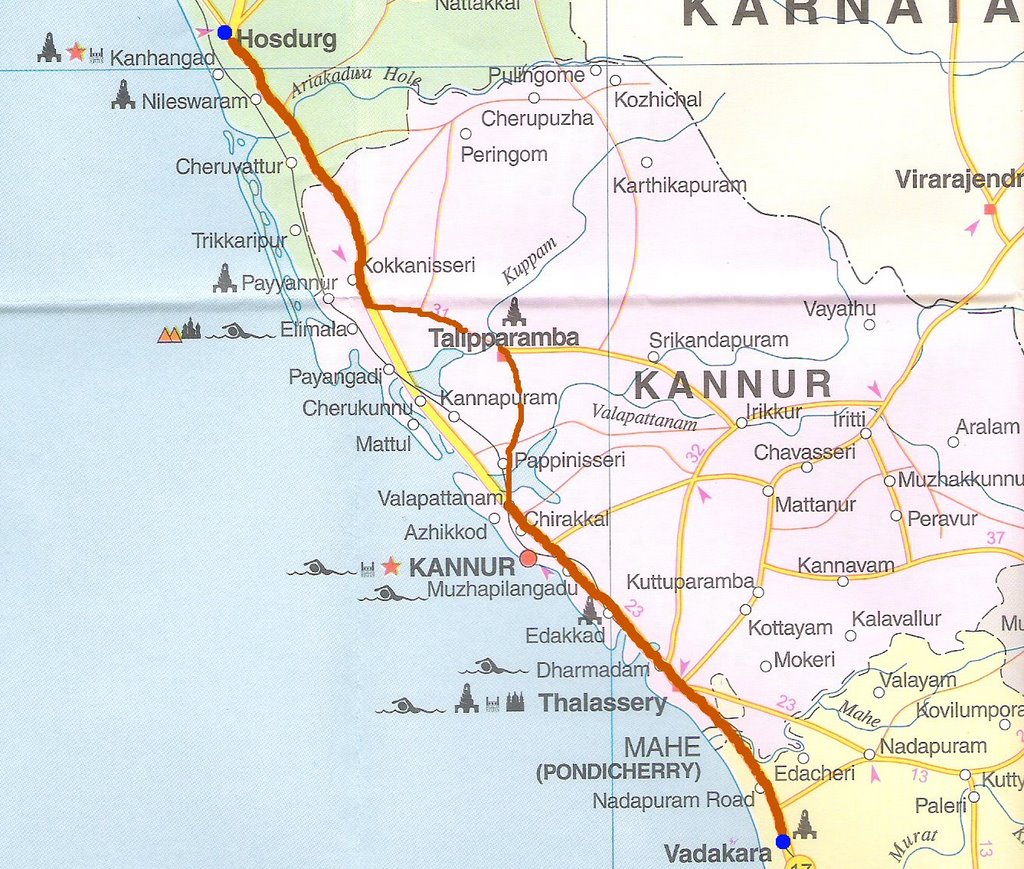
Day 22: Kanhangad – Vadakara

I had a good night’s sleep, despite the railway line right beside the ashram. I woke at five to the sounds of recorded bhajans and prayers. A volunteer showed us the artificial caves there. The story goes that around 1900, Bhagavan Nityananda constructed these caves here and the local people filed a petition against him claiming that he was stealing money. A British official came to investigate and Bhagavan Nityananda jumped into a nearby water tank and pulled out a bag of gold coins saying “I get money from here whenever I want." The official was so pleased that he just gave all that land to Bhagavan Nityananda for his use!

We were also served morning tea. Partly to help these guys carry on the good work and partly to soothe Shyam’s guilt feelings about the free food and accomodation here, we donated some money into the hundi.

We left at 6:30am along a great NH17. We reached Payannur (28km) at 8:45am and had our fill of pineapple and cashew juice. 5km further on, we left NH17 to take a shorter state highway to Kannur, saving 7-8km over the national highway route.

The state highway had a few climbs initially, but it was in good shape. The Kanhangad - Kannur distance reduced to 62km by using this route. It rejoined the NH 7km before Kannur, from where it was one hot, sweaty trek across the city of Kannur to Thottada, some 6km beyond it, where we had arbitrary grub at some arbitrary canteen. We walked a little further on where a housekeeper allowed us to rest in his orchard. We had fresh pineapple slices & grape juice for dessert and relaxed.

In the evening, we followed a highway that often crossed the rail tracks and kissed the sea at times. Through the narrow, twisting lanes of Telichery (Thalassery) (27km), up a climb and descend, cross a creek to enter...


...Mahe (37km). The road guide says Mahe has "sea-skirting roads and unique French flavour", but they forgot the trees. The surprising greenery that comes out of any nook and cranny, even in these hot summer days. The highway in Mahe is just a 1-2km stretch and lined prominently by booze bars. Pondicherry was thus the shortest and easiest state to pass through in our journey.

We continued a little beyond Pondicherry for Vadakara (Badagara), but it was getting dark. Shyam fell while trying to mount the highway from the shoulder. No serious injuries, but his pedal got bent to hit the cycle. Some rudimentary repairs later, we continued in darkness – there was a power cut in the entire area.

We reached Vadakara at 8:30pm, which was too late for dinner. Settled for some parathas and went and had a bath in the police station.

Today we must have broken the distance record for the trip by cycling 105km, but there's not much exhaustion to show for it, save for a slight hint of undie bite. In fact, my ankle stopped hurting once I removed the anklet that I was wearing to protect it. Maybe the roads are getting better and better – or are we just getting “studder”?

Lightning on the horizon tonight. I wonder...?

Monday, May 26, 1997

Day 21: Mangalore – Kanhangad

We set off at 7:30am, aiming for Kasargod (50km) by lunchtime. The highway was not as good nor as flat as it was yesterday, and there were innumerable ups and downs. Not an easy 50km, but we had the enthusiasm of crossing the state border today. 17km from Mangalore, the border is an innocuous signboard. A pleasant surprise was a milestone with “Kanyakumari 734km” on it.

We had our breakfast 33km from Mangalore in the shade of a banyan tree. There were no noticeable effects of crossing into Kerala – in fact, Kannada was prominent well into Kasargod district.


Reaching Kasargod by noon, we had cheap lunch near the bus stand. From Kasargod, the national highway takes a longer inland route to go south, while the state highway is a more direct route to Hosdurg. We followed this road a few km and then rested in a palm grove for the afternoon.

I removed and unpacked my bag to write this report to find – jam! Never had I thought jam could get into so many places so fast. Luckily, most of my stuff was packed individually in plastic bags, but cleaning all of them and washing a blanket and t-shirt was a trying experience. Most of the jam was salvaged in the end but it remains a problem what to do with it.

I sprained my ankle sometime during the afternoon halt. To top it all, my goggles went missing, possibly flicked. Today is just not my day.

Thankfully, the road in the evening was a joy to cycle on. It goes beside the railway tracks all the way and at times gives a good view of the sea. At Bekal (14km), there is a stretch parallel to the beach on one side and the rail lines on the other. Not quite like Maravanthe, since the beach is lined with traditional houses.

The Bekal fort is half a km from the highway and worth a visit. It was once a Tipu Sultan fort and has the sea on two sides. A smallish fort, the caretaker let us take our cycles in and waived our entrance fees. A nice English-speaking chap.

I met a guy called Vinod who was doing his 2nd year Computer Science in Manipal Institute of Technology. A friendly guy, he told me a little about the area. Finally, we left the fort to reach Kanhangad at dusk. What is given as Hosdurg on the map is actually Kanhangad. Hosdurg is the fort in the city.

At Kanhangad, the police surprised us by refusing us accomodation, albeit politely. One policeman recommended an ashram half a km away.

The Sadguru Nithyananda Ashram is a memorial to a holy man of that name who attained Samadhi in 1961. It has volunteers and a trust and seems quite popular and well off. The people in charge allowed us to sleep the night. They are very kind and courteous, unlike some temple priests I remember from the trip. (The ashram is not a temple) They even gave us dinner of rice and sambar, which we ate indoors in the light of a petromax.

It is 9:15pm and a cool breeze is blowing in the courtyard of the ashram. After finishing this report, I’ll have a bath and then a well-earned sleep to rest my ankle.

Estimate of distance covered today: 76km

Sunday, May 25, 1997

Day 20: Udupi – Mangalore

This is a jump in the day numbering, as I have eliminated the two days I relaxed in Udupi as Krishnan and Shyam went to Mysore, Belur & Halebeedu.

They returned today morning at 5:30. We left Udupi after lunch. After three full days without cycling, we were rejuvenated. Even my cycle had stopped its routine creaking. I left Udupi with a light heart and a heavy bag – stuffed with laddoos, chips, sweets and jam – a whopping 1kg jar of it!

The Udupi-Mangalore stretch was 60km long, and a well-laid highway. We made really good speed, stopping by KREC Suratkal (40km) for water and a look around.

Just after Suratkal is New Mangalore, a port city. At this point, the highway became four laned and incredibly smooth. We zipped along to reach Mangalore, just as darkness enveloped the large city.

After an OK dinner, we went and parked at the police station at Pandeshwara, among some really inquisitive and helpful policemen. The excellent highway was responsible for our record-breaking session in the evening. However, one has to be careful on the Kundapura-Mangalore stretch. There is a lot of heavy traffic and all of it travels at high speed. A few times, I had near misses when trucks or buses passed me by a couple of inches. Definitely not a stretch to be done at night.

After a good bath in the police station complex, we spread our carrimats and slept, at the base of a general statue of a policeman.

Estimate of distance covered today: 60km

Thursday, May 22, 1997

Day 19: Kundapura – Udupi

Not much cycling today. We set off at 6:30am from Kundapura after having milk. The monsoon clouds steadily gathering day by day ensured a dark, cloudy sky, and our ride to Udupi was very peaceful. I surprised Krishnan (and myself!) by remembering the way to Harinivas (my grandma's place) from the highway. Touched at 9:30am. The first thing we did was have a good bath and wash away all the accumulated dirt and stink of the past few days.

In the afternoon, after a good sleep, we took a walk around. I took Shyam & Krish around the temple areas. Both of them intend to make a bus trip to Mysore, Belur & Halebeedu in the next few days. They went and booked tickets for the 9:45pm bus to Mysore.

Estimate of distance covered today: 36km

Wednesday, May 21, 1997

Day 18: Honnavara – Kundapura

We woke up early – 4:30am. It’s become a habit by now! Our plan was to make Bhatkal (38km) the afternoon halt. But an incredibly smooth highway and the partly clouded sky made for good speed. I stopped a few minutes at Shiruru to encash a Travellers Cheque and moved on again, making the most literal use of a TC! Reaching Bhatkal by 10am, we decided to make Baindur our afternoon halt, thus cycling a record 57km in the morning session.


We had OK grub at Baindur. Instead of sleeping the afternoon away as usual, we caught a bus for Kollur, about an hour’s journey. There is a Mookambikeshwara temple here. Kollur town is set amongst green hills. We reached at two, but had to wait until three for the temple gates to open.

After viewing the temple, we waited till 4:30pm for the return bus. Plenty of buses to Kundapura - Udupi - Mangalore and even Kerala(!), but few to Baindur. Sitting in the bus, I enjoyed what I'd missed by sleeping on the forward journey – an evergreen forest through which the rough hill road twists and turns.

From Baindur, the highway quality deteriorates but we fought for speed to watch the sunset at Maravanthe, halfway to Kundapura.


Kundapura was our night halt. Good home-flavoured dinner - I can feel Udupi’s proximity!. As usual, the police were very helpful but they could not do anything about the water shortage. We were forced to sleep without a bath.

Today we contacted three police stations – or rather four if we count Honnavara.

• Bhatkal – for information about the area in general and Baindur in particular.
• Baindur – for permission to leave our cycles as we bused to Kollur.
• Kundapura – for night halt.

What surprised me was that each police station seemed to have contacted the next (over the wireless possibly), so that the police seemed well informed and ready for us as we arrived. This kind of concern was totally unexpected from a force that is projected in the mass media as lethargic and aloof from the people. Earlier too, there were vague signs that a police station knew of us beforehand but this was the first time it hit us so directly. As soon as I entered the PS at Baindur, the on-duty officer said, “Oh! The cycle tourists. What can I do for you?” I was touched.

Estimate of distance covered today: 90km

Tuesday, May 20, 1997

Day 17: Jog Falls – Honnavara

Without any watches or clocks, we let dreams take over and slept till nine. After a relaxed toilet and heavy breakfast by the falls, we started descending by the steps to the base of the falls.

What a sight! I put each foot slowly down the steps, drinking in the climate, the vegetation and the view of the falls as I descended. It was a good walk. Once down, we clambered over rocks and small streams to reach the base, a small pool fed by four individual streams. Looking around, it was a claustrophobic sight. Remembered Kiran's description of the Grand Canyon, and suddenly made up my mind to go hiking there next! Above, the wind and sun played tricks with the falls – taking individual streams and twisting and funnelling them, before finally converting them to magical mist which swirled and danced as it floated down. There was not much water in the falls as compared to the photographs displayed in the tourist shops above, but the falls are still worth a visit in the height of summer. In fact, I later discovered that in the monsoons, it would be impossible to descend the steps and go within touching distance of the falls – a not-to-be-missed experience.

We wanted to have a bath under the waterfall (à la Liril?) The rightmost fall – I forget its name – is the only one accessible for this purpose. I wove my way carefully through the slippery rocks and stopped just short of the falling water. By here the spray was like rain, falling thick and heavy and accompanied by the chilling wind – now where did the wind come from?

I went and dried myself naturally on the rocks by the pool, looking around at the awesome view. Downstream, the waterfall had cut its way through the stratified rock, and forests had taken over the steep slopes the waterfall had once created. At places, narrow strips of forest had come down almost to the valley floor, making me think of them as “greenfalls”. Various birds had made their home in the numerous crevices on the slopes. What a place to live!

We hardly realized how the time flew. By the time we started up again, numerous cool drink sellers had established themselves on the way – they looked surprised and asked us when and where we’d come from! We made our way up the path strewn with empty tetrapaks, aluminium foil and plastic littered by careless tourists. The tourist pressure was currently 50-100/day, but it can increase to about 3000-4000 a day in the “season” – the rainy season, that is. Another advantage of coming in the summers?

There is a hydroelectricity plant a few km downstream, but it was closed to tourists after the Cauvery water dispute arose. We might have got in with our IIT cards, but decided against it. We were hungry, and it was afternoon – we had plans of cycling to Bhatkal in the evening. Fortunately or unfortunately, there were no immediate buses from Jog to Honnavara, so we had a good trek down the road back to Mavinagundi, where we had a tense lunch of idlis, waiting at any time for a bus that was already late.

It never turned up. Later we had some locally prepared pineapple juice, and sat by the forest check post looking for transportation that was bound to stop there. Still no buses. It was turning five. Had to give up on the idea of cycling today. Honnavara is 57km from here, and it takes two hours by bus.

Most of my treks seem destined to involve a ride in a truck, and the time seemed to have now come. At five, an LCV stopped at the forest check post and the driver agreed to take us. We climbed in at the back. After seeing so many cool drinks at the tourist town, it seemed appropriate that the truck was carrying cool drink bottles. We sat on a tarpaulin on the crates.

The initially few km through the dense forest were really great. Shimoga! I made up my mind to explore this district and surrounding area by mobike sometime in life. Cycling, that’d too difficult over the hilly terrain.

The road was not that rough, but sitting on cool drink bottles was a little uncomfortable. Krishnan became sick a couple of times. The truck stopped a few times on the way to drop off some crates at restaurants and bars. Later I shifted to a prone position which I discovered was more comfortable. It was a memorable ride in the evening. I saw dark clouds gather overhead. Please! No rain so soon! As such we’re lucky not to experience the pre-monsoon showers the Deccan gets around this time. Thankfully, no showers today. Lying prone on the crates, we discussed the interesting shapes the clouds appeared to make. We got down at Honnavara and had dinner at a large clean Kamat restaurant.

Madhu left us tonight to return to Bombay. He has some academic tensions, having received news that he got an EE in a core course. So now we're down to three. Before leaving, Madhu treated us to ice-cream. We shared a litre pack which turned out very filling. Finally slept without having a bath in the mosquito-infested police station. No cycling today.

Monday, May 19, 1997

Day 16: Ankola – Jog Falls

Surprisingly, all of us were up early, and we moved before sunup for Gokarn along a country road. We had to take a ferry on the way. We reached Gokarn early, but not early enough to evade the hordes of tourists who had come by private tour buses to see the famous temple(s) here.

The temples at Gokarn were an eye-opener for me as to what all a temple must not be. The temple trust seems to have allowed itself to become commercialized along with the town. The pujaris assail you as soon as you enter the temple complex, and ingratiatingly ask you to perform this aarti for 31 bucks, or that puja for 101 bucks.

Gokarn town is a temple town like Udupi, but on a smaller scale. But the similarities end there. Among the more arbitrary rules the temple has made for its devotees are:

1. A bath in the sea is compulsory before entering. (however, Shyam and I slipped in bathless)

2. There is an “entrance fee” of 50ps for the Ganpati temple and Re1 for the Gokarna temple. However, in return the temple doesn’t provide any facilities for the devotees such as bathing ghates, toilets or footwear stands for that matter.

3. Shirts, vests and cameras must be removed before entering the temple. Inside, it was hot, humid and stuffy. There was confusion as a lot of people tried to crowd into a small place and touch the deity. The pujaris ordered people around impatiently. One of them in fact directed us on a reverse pradakshina.

4. There are fines for disobeying rules such as Rs1.50 for bringing in footwear and Rs10.00 for getting in a camera or spitting. These fines are allegedly for prayaschitta, the concept of "paying for one's sins" that I thought had gone out with the Renaissance.

5. Of the most dangerous ones – persons suffering from leprosy are not allowed into the temple.

This was definitely not my idea of how a place of worship should be like. If people prefer to pray this way, so be it. But I would prefer something like the Kodavoor devasthana, or the churches of old Goa any day.

Surprisingly, Krishnan said he liked the temple, which just goes to show how differently two people can feel about the same thing. But then, Krishnan likes all temples!

We left Gokarn and went to Kumtha by another country road. This too involved a ferry, and the Gokarn-Kumtha distance reduced to about 20km – much shorter than the highway route, which is about 38km. The country roads we took from Ankola to Kumtha were rough and uneasy to ride on unlike the highway, but then again, in contrast to the highway there was no pollution at all – the grimy dirt that sticks to you and is hard to remove, unlike the red mud and dust of the countryside, which is tolerable.

We had decent food by the Kumtha bus stand. There was a strange system of a different table for each individual diner, and the first time on the trek we were served each item separately on our plates (which were initially empty).

A warning for future travellers – water crisis! The shortage of water starts right from Ankola and en route we were desperately hunting for good quality clear water. All the tap water we had on the tour so far was ok and no one upset his stomach, but the water quality on this stretch made us decide not to push our luck. Be sure to carry lots of water – especially off highway.

Later in the evening, we covered the distance of 17km to Honnavara uneventfully. The only strange thing I remember is seeing a thatched house with brand-new Mangalore tiles. It did look a little odd. Then I remembered Prof Date’s observations on villagers – that when they come into money, the first thing they’ll do is get a good rain-proof roof, next good walls an so on downward.

We reached Honnavara bus stand and enquired about buses to Jog. It turned out all the night buses to Bangalore take that route. So we went to the police station, unpacked all our stuff in a safe place and put all the essentials into one bag.

At 6:45pm, we boarded the Bangalore bus but did not get seats immediately. Everyone was staring at us in our dishevelled state. We were wearing shorts and Madhu, a pair of jeans torn in n places. Even the conductor was rude to us initially, but as he learnt who we were, and what we were up to, he got talking. We became really friendly and he cautioned us to the various dangers of cycling.

After some time, we got seats and an opportunity to observe the excellent ghats and forests in the darkness. The road cut through the hills and was at stretches lined with high walls of rock on either side – blackish red rock. A sight that is so typical of Karnataka! As we rode on, memories of other bus rides through forests flashed through my mind – memories of Assam, of Untoorkatte, of Sariska… Gradually, however, the rocking motion of the bus lulled me to sleep.

The bus stopped for dinner at a decent place at Mavinagundi, some 5km from Jog Falls. At Jog, it was too dark to see the waterfalls but we could hear the water. Jog is a small but well laid-out town, and the effects of the Falls and the associated dam are seen – a lot of streetlights and supply of water.

It was a beautiful night and without any encumberances like cycle, luggage et al, it was ideal to sleep outside. Unfortunately, we had not got much bedding or carrymats and Shyam – the Madrassi – was feeling cold. So we took a room in the Youth Hostel for Rs.100 the night and settled in. The Y.H. was well equipped with mattresses and clean bedding, running water in the bath etc. Only it seemed odd that not many youth were there – it catered mainly to the middle aged and old tourists who came by package tour buses.

Later, Krishnan and I went a bit up the road where it was dark and lay down on the road by the canal, watching the fireflies. Had a long talk on everything under the moon, till we, to borrow from Jerome K Jerome, common-place, everyday young men enough, felt strangely full of thoughts, half sad, half sweet, and did not care or want to speak.

Sunday, May 18, 1997

Day 15: Kankon – Ankola

In the morning, we decided to try a shortcut given on the map instead of the roundabout highway route, only to discover there are no bridges across the two creeks of Tapona and Galjibaga. Determined to have our shortcut, we pushed our cycles up to the Konkan Railway line, and followed it all the way across Galgibaga. Perhaps the highway might have taken lesser time, but this was something new. We nonplussed a few KRC workers who just couldn’t understand our idea of leaving the highway to cycle on rail tracks.


Across the creek at Maxem, we dismounted the tracks and met the highway. Here we had our breakfast of a strange kind of “Goan bread”, which looked like puris.

The highway was wide and smooth, and we made good pace to cross the Karnataka border and reach Chittakula some 7km before Karwar. Here we had to wait while Krishnan cycled back to search for his watch, which he’d forgotten at the border. He couldn’t find it. Finally, we went on to Karwar and had decent food.

Karwar has a beautiful bay and coastline, and supposedly a fine harbour. We pushed our cycles through the sand to rest in a pine grove just before the beach, keeping an eye out for crap, lovers and buffalos.

Since no one had a watch now, nor the enthusiasm to remove the alarm clock from the bag, the time flew and before we knew it, it was five. We had GKRs and took the highway for Ankola (33km). After the first few ghats, this was a really tireless ride through forest. Now we understood how a kilometre on a highway (rather, a national highway) is different from a kilometre on a country road.

We saw the Konkan Rail almost all the way to Ankola. Apparently there's a train from Mangalore up to Kankon, which explained why the signals on the lines were working. At Ankola, we used our Kannadas (Madhu, me, and a smattering of Krishnan) at the Police Station and got accomodation in a veranda, near a mini-temple of sorts. Then went for dinner, during which none of us drank the extremely suspect water served. Even at the Police Station, there's very little drinking water but enough general water for a bath.

Sleeping now at eleven. Will try to wake up early tomorrow. Let’s see…